
A trip’s fuel cost depends on three things: its distance, your vehicle’s real-world fuel economy and the pump price where you fill up. The UK’s weekly road fuel figures offer a national benchmark, but they cannot tell you the price at a particular forecourt or exactly what your vehicle will use. For a useful budget, combine a realistic journey distance and fuel economy with a local price checked for the fuel you use.
Calculate fuel cost from miles per gallon
For a vehicle rated in miles per gallon (mpg), first divide the journey distance by the vehicle’s mpg to estimate how many gallons it will use. Then convert gallons to litres and multiply by the price per litre. UK forecourts display prices per litre, so that conversion lets you use the pump price directly.
Estimated cost = journey miles ÷ mpg × 4.546 × price per litre in pounds
There are 4.546 litres in an imperial gallon. Because a UK gallon is imperial, use the vehicle’s UK mpg figure where available. A US mpg figure uses a smaller gallon and should not be entered directly into this formula; doing so would make the estimate inconsistent with the conversion factor.
For a return journey, include the distance in both directions. If your vehicle’s consumption is given in litres per 100 kilometres instead, convert the journey distance to kilometres, multiply by that consumption figure and divide by 100 to estimate litres used. Multiply those litres by the local price per litre. In either method, the result is an estimate based on the distance and consumption figure you supply.

Worked example: a 60-mile return journey
Suppose a return journey is 60 miles and a car averages 40 mpg. The estimated fuel use is 60 ÷ 40 = 1.5 imperial gallons. Converting that amount gives about 6.82 litres.
To estimate the cost, multiply 6.82 by the price per litre shown at the station you plan to use. If you enter a local price of £P per litre, the calculation is 6.82 × £P. This example shows how to apply an actual local price without presenting an unverified pump price as current.
The estimate is not a guarantee of what you will spend. Traffic, speed, hills, weather, vehicle load, tyre condition and driving style can affect fuel consumption. A manufacturer’s stated mpg may differ from your usual real-world figure, so a recent personal average can make the calculation more relevant to your journeys.
Use the weekly government figures as a benchmark
The Department for Energy Security and Net Zero publishes UK road fuel price data and related petroleum product statistics. The government’s road fuel and petroleum product prices collection is where to find the latest available official figures. Check the reporting period shown with the figures before using them.
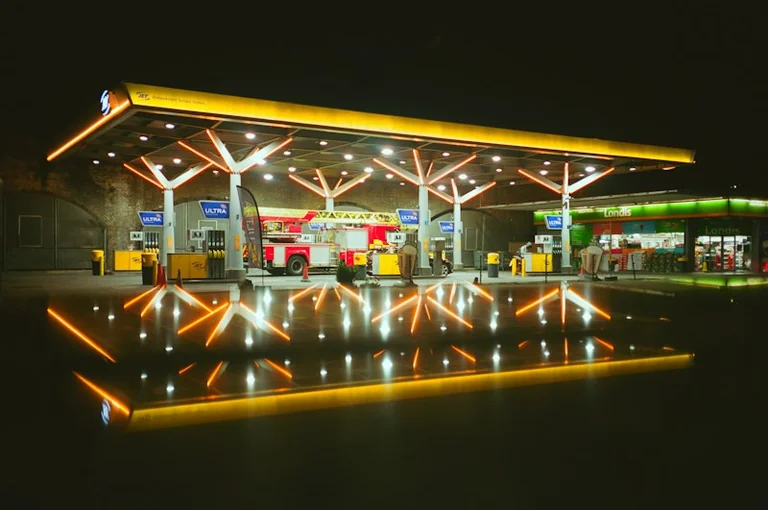
A national average gives context for the broad UK price level and can help you judge whether a local price is above or below that benchmark. It is not a live quote for every station, nor does it show what a particular forecourt will charge when you arrive. Nearby stations can have different prices, and the published data may cover a period before your journey.
Compare local prices for the route
For a trip estimate, check prices displayed by forecourts you could realistically use along your route. Compare the same fuel type—petrol with petrol or diesel with diesel—and note when you checked each price. A lower price may reduce the estimated bill, but a detour adds distance and fuel use, so include it if you plan to drive out of your way.
To compare two stations, calculate the journey cost at each price using the same distance and mpg. The difference between the results shows how much the price gap changes the estimated fuel bill. This keeps the comparison focused on the local prices you could actually pay, while the official weekly figure remains a separate national reference.
Match the estimate to the journey
Use a distance that includes the return leg and any planned stops. If you track your own fuel economy, use a typical figure; otherwise, treat the vehicle’s stated mpg as a starting point and account for conditions that may make your journeys less efficient. These choices matter because changing either the distance or mpg changes the amount of fuel in the calculation.
Check the official collection for the latest published national benchmark, then use the chosen station’s displayed price for the local estimate. Check the pump price again before a later journey: the weekly reporting period and the price you see at a forecourt may refer to different times.
Source: UK Government, Department for Energy Security and Net Zero
Context & actions About this article
Source check Price and calculation notes
The government dataset provides a weekly national benchmark; use the price at your chosen forecourt for a local trip estimate.
- Check the reporting period of the latest published figures.
- Use the price for the correct fuel type at the station you plan to visit.
- Use UK miles per gallon and convert gallons to litres when working from a per-litre price.
- Source
- Department for Energy Security and Net Zero
- Scope
- United Kingdom
- Updated
- 2026-10-17 08:52
Source check
Report a trust issue
Send a clear signal to community moderation if the source, facts or context need review.



Comments