
On 25 August 1919, a converted de Havilland DH.4A left Hounslow Heath Aerodrome near London for Le Bourget outside Paris. Operated by Air Transport and Travel, the flight launched what is widely identified as the world’s first regular daily international passenger air service. Its importance lay not simply in crossing the English Channel, but in offering to make that crossing again the next day—and on the days after that.
The inaugural service carried just one passenger. That modest beginning stands in sharp contrast to modern aircraft capable of moving hundreds of people between London and Paris in a single departure. Yet capacity alone does not explain the flight’s place in history. The decisive change was the timetable: international flying was beginning to function as transport rather than an isolated demonstration.
- Air Transport and Travel opened the scheduled route between Hounslow Heath and Le Bourget.
- A converted wartime de Havilland DH.4A was used for the early service.
- The first flight carried one passenger, not a modern cabin full of travellers.
- Its daily schedule distinguished it from experimental, mail and occasional charter operations.
Civil aviation emerged from the machinery of war
The service began less than a year after the First World War ended. Aviation had developed rapidly during the conflict, but its aircraft, airfields and operational experience had largely been shaped by military requirements. Peace created a different question: could those resources support dependable civilian transport between countries?
Air Transport and Travel was among the companies attempting to answer that question commercially. The London–Paris route was an obvious test. The two capitals were major centres of government, business and culture, while the Channel gave air travel a potential advantage over journeys requiring a sea crossing.
That opportunity did not make early flying easy. Operators faced primitive navigation, exposed grass airfields, limited weather information and aircraft whose reliability and passenger accommodation bore little resemblance to modern airliners. A scheduled departure could be advertised, but weather and mechanical limitations still had considerable power over whether the journey proceeded as intended.
The passengers who used these services were therefore not buying the predictable experience associated with present-day commercial aviation. They were entering a young transport system still adapting military technology to civilian needs.
The DH.4A was an adaptation, not a purpose-built airliner
The aircraft associated with the opening service was the de Havilland DH.4A, a converted version of the wartime DH.4. The conversion represented the practical reality of immediate post-war aviation: existing military designs were available, while a mature industry producing purpose-built passenger aircraft had yet to emerge.
The DH.4A could accommodate a passenger in an enclosed position, but it should not be imagined as a miniature version of a modern airliner. Space was restricted, capacity was extremely low, and the experience lacked the pressurisation, climate control, sound insulation and cabin services now taken for granted.
Its use nevertheless showed how wartime aircraft could be redirected toward a civil network. The aeroplane was no longer being employed for reconnaissance or combat. It was carrying a fare-paying traveller between two countries according to a published service pattern.
From one passenger to high-capacity aviation
The single passenger aboard the opening flight makes the scale of the experiment clear. Today, one short-haul aircraft can carry many times the total number of people that an early DH.4A service could have moved through repeated departures.
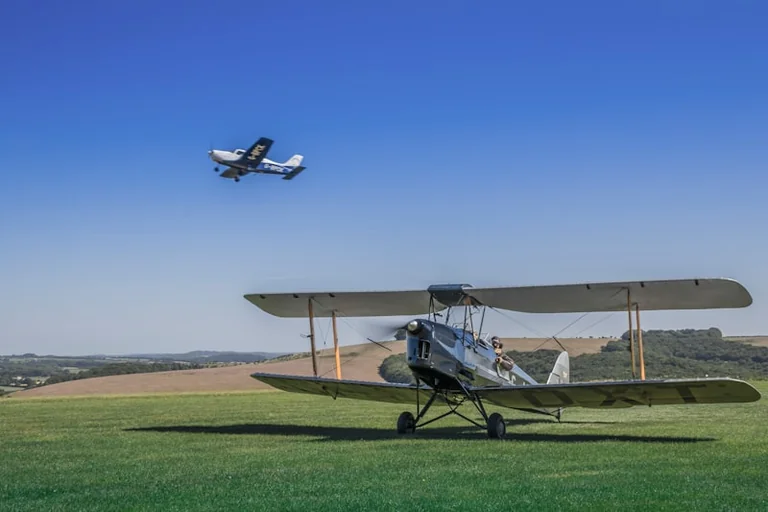
Modern capacity rests on developments that the 1919 operator did not possess: dedicated passenger cabins, more dependable engines, instrument navigation, air traffic control, paved runways, coordinated airports and extensive maintenance systems. The comparison is useful because it reveals how little of the modern aviation system existed when the route began.
It would be misleading, however, to judge the 1919 service only by comfort or passenger numbers. The more important question is whether an operator was attempting to provide repeatable international transport. On that measure, the Hounslow Heath–Le Bourget operation marked a significant change.
Why the daily timetable mattered more than the crossing
Aircraft had crossed borders and the Channel before August 1919. Earlier flights included experiments, demonstrations and operations carrying mail, while charter arrangements could serve particular customers or journeys. Those achievements contributed to aviation’s development, but they did not necessarily create an everyday passenger service.
A one-off flight proves that a journey is possible. A scheduled service makes a broader promise: an operator intends to provide the same connection repeatedly, on stated days, for passengers who can plan around it. That promise is the foundation of an air transport network.
The distinction also explains why claims about aviation “firsts” require careful wording. The 25 August service was not the first time an aircraft had crossed the Channel, carried something commercially useful or moved a civilian passenger. It is widely recognised for combining several specific features: it was international, passenger-carrying, scheduled and intended to operate daily.
Regularity transformed the meaning of the aircraft. Instead of being chiefly a machine for spectacle, experiment or a special commission, it became part of a route. London and Paris were no longer merely points reached by an exceptional flight; they were endpoints in an emerging transport system.
A short timeline of the milestone
- November 1918: The First World War ended, leaving aircraft, trained personnel and aviation infrastructure available for civilian adaptation.
- 25 August 1919: Air Transport and Travel launched its scheduled passenger service from Hounslow Heath to Paris-Le Bourget.
- After the inaugural flight: The route’s historical significance came from its intended daily repetition, not from treating the first crossing as an isolated feat.
- 25 August 2026: The launch reaches its 107th anniversary.
How the route entered British Airways history
British Airways places the 1919 London-to-Paris service within its corporate historical lineage. Air Transport and Travel was an early predecessor in the sequence of British aviation companies and consolidations that ultimately led to the present airline.
That lineage should not be confused with continuity of aircraft, airports or passenger experience. The organisation, technology and regulatory environment of contemporary British Airways are separated from the DH.4A operation by more than a century of change. The connection is historical and corporate: the 1919 service represents an early branch of the family tree.
The anniversary therefore marks more than the departure of one small aircraft. It identifies a moment when international passenger aviation acquired a defining feature of public transport—a recurring schedule. The converted biplane and its lone passenger did not resemble today’s high-capacity industry, but the route introduced a principle that remains central to it: travellers could expect an airline to connect two cities again and again.
Source: British Airways
Context & actions About this article
Source check Historical context
The date, route and place in British Airways history are presented using British Airways material and a secondary history of Air Transport and Travel.
- British Airways places the 25 August 1919 service in its corporate historical lineage.
- Air Transport and Travel operated the scheduled Hounslow Heath–Le Bourget route.
- The milestone is described specifically as a regular daily international passenger service...
- Earlier experimental, mail and charter flights are not treated as the same type of schedul...
- Source
- British Airways: History and heritage
- Scope
- United Kingdom and France
- Updated
- 2026-08-25 19:09
Source check
Report a trust issue
Send a clear signal to community moderation if the source, facts or context need review.



Comments