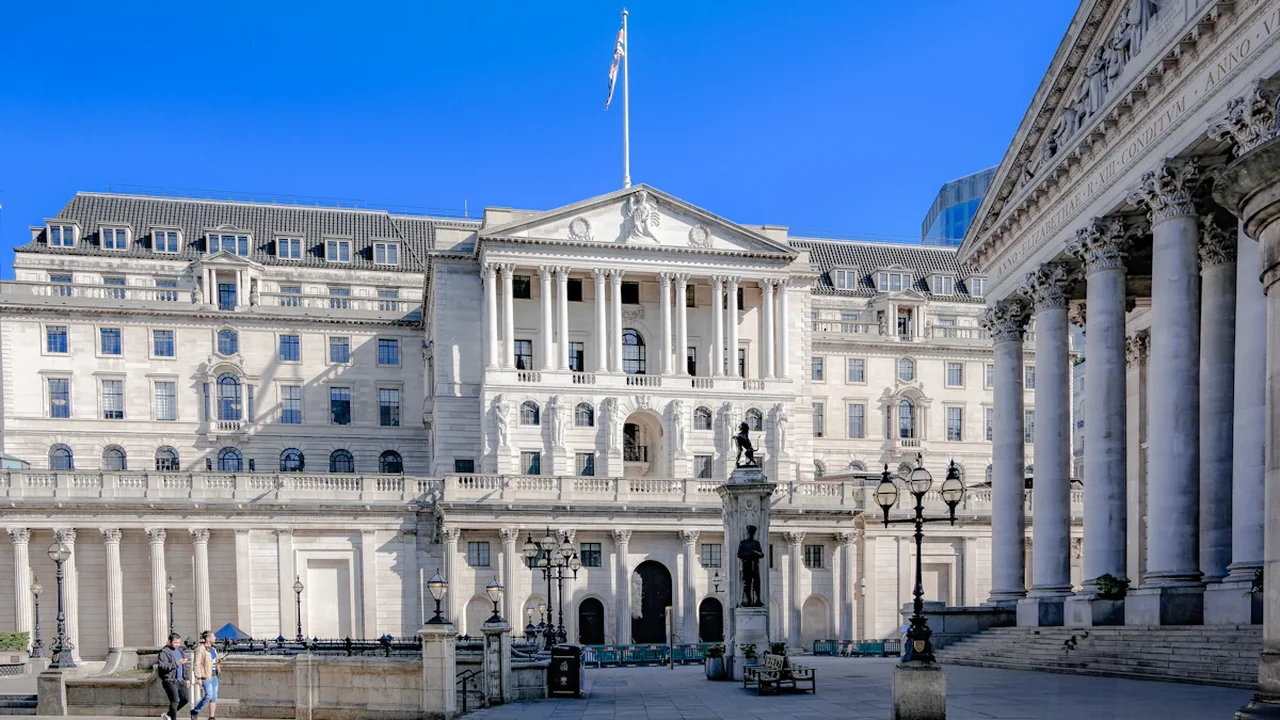
The Bank of England’s published Bank Rate and rate history provide the starting point for a question with consequences for UK borrowers and savers: will the rate in force at the end of 31 December 2026 be lower than it was on 25 September 2026? The answer will come from the Bank’s official record. A lower Bank Rate could influence mortgage and savings offers, but it would not automatically change every household’s rate.
The forecast in five lines
- Question: Will Bank Rate be lower at the end of 31 December than on 25 September 2026?
- Deadline: The comparison uses the rate in force at the end of 31 December 2026.
- YES: The year-end Bank Rate is lower than the rate in force on 25 September.
- NO: The year-end Bank Rate is unchanged or higher.
- Deciding record: The Bank of England’s Bank Rate page and rate history.
Why the September starting point matters
This forecast is a comparison between two dates, rather than a prediction that any particular rate decision will be a cut. The Bank of England publishes Bank Rate decisions and maintains the history needed to identify the rate in force on each comparison date. That history is the place to check the exact September starting figure before making a numerical claim about the size of any change.
The distinction matters because a rate can move more than once before year-end. A cut after 25 September would create a possible path to YES, but it would not settle the question if a later increase reversed it. Equally, a decision to leave Bank Rate unchanged at the next meeting would leave time for a subsequent change before the deadline.
The test concerns the rate in force, not merely the date on which a decision is announced. If the Bank announces a change with a later effective date, the effective rate on each comparison date is what matters. Reading the relevant entries in the official history avoids treating an announcement as though it had already changed the applicable rate.
How Bank Rate can reach mortgage borrowers
Bank Rate is the central bank’s policy interest rate. It influences the wider cost of money in the economy, but it is not the mortgage rate printed on a household’s agreement. Lenders set their own offers and take account of funding costs, competition, credit risk and the terms of each loan. A lower Bank Rate therefore does not promise an immediate or equal reduction in a new mortgage quote.
For existing borrowers, the connection between Bank Rate and mortgages depends heavily on loan terms. A borrower on a fixed rate generally keeps that agreed rate until the fixed period ends, even if Bank Rate changes in the meantime. Someone on a tracker may see a change tied to Bank Rate under the product’s formula and timing rules. A standard variable rate can move at a lender’s discretion, so the response may differ between lenders.
For a household approaching the end of a fixed deal, the timing of a new offer may matter more than a single policy announcement. Lenders can adjust quoted fixed rates in anticipation of future interest rates, and offers may move for reasons beyond the latest Bank Rate decision. Comparing the total cost of available deals, including fees and the rate after any introductory period, gives a fuller picture than comparing headline percentages alone.
Borrowers should also distinguish a lower monthly payment from a lower total borrowing cost. Extending a mortgage term can reduce the monthly bill while increasing the interest paid over the life of the loan. Anyone assessing a remortgage or a new loan needs to consider the loan amount, repayment period, fees and the terms they can actually obtain.
What a change could mean for savings and businesses
Savers face a similar gap between the policy rate and the rate on their account. Banks and building societies choose the interest rates they pay, subject to the account’s terms. Easy-access rates can change, while a fixed-term savings product normally has its own agreed rate for its term. A Bank Rate cut may lead to lower offers on some accounts without changing every existing account on the same day.

The practical question for savers is the rate their provider currently pays and whether that rate is variable or fixed. They can compare it with other available accounts while checking access restrictions, withdrawal penalties and eligibility rules. The year-end forecast alone cannot tell a saver what return a particular account will deliver.
Businesses can also be affected through the price of borrowing and the return on cash holdings. As with household products, the outcome depends on contract terms and lenders’ decisions. Some financing costs may respond more directly to policy changes than others. That is why the forecast’s public answer can be clear even while its effects across the economy remain uneven.
The routes to YES and NO
A YES outcome requires one fact: the Bank Rate in force at the end of 31 December must be below the rate in force on 25 September. One or more cuts could produce that result, provided later decisions do not fully reverse them. The rule does not require a particular number of decisions, a specified size of cut or a matching fall in mortgage rates.
A NO outcome covers both an unchanged year-end Bank Rate and a higher one. It also covers a sequence in which Bank Rate falls during the intervening months but returns to its September level by year-end. For this question, the final comparison matters more than the route taken between the two dates.
There is genuine uncertainty in both paths. The Bank of England can reassess policy as economic conditions develop, including inflation and the strength of economic activity. The available source establishes where decisions and rate history can be checked; it does not establish what future decisions will be. A confident claim about the year-end direction would go beyond the public facts available at the September starting point.
Nor should the forecast be read as a verdict on whether mortgage costs as a whole will be lower by New Year’s Eve. Bank Rate is one input into borrowing costs. Product rates, fees and individual circumstances determine what a person can actually pay. The forecast deliberately asks the narrower question because the official rate can be checked consistently for everyone.
How to check the result on 31 December
The final check is straightforward: find the Bank Rate effective on 25 September 2026 in the Bank of England’s rate history, then find the rate in force at the end of 31 December 2026. If the second figure is lower, the answer is YES. If it is the same or higher, the answer is NO.
Until then, each published Bank Rate decision can change the possible path without necessarily deciding the outcome. Readers weighing a mortgage renewal or a savings choice can follow those decisions, but should check live product terms separately. The next Bank of England decision, and eventually its year-end rate history, will show whether the policy rate moved in the direction this forecast tests.
Source: Bank of England
Context & actions About this article
Source check How this forecast is decided
The outcome depends on the Bank of England’s Bank Rate in force on two specified dates, not on individual mortgage or savings rates.
- Check the Bank Rate effective on 25 September 2026.
- Check the Bank Rate in force at the end of 31 December 2026.
- Resolve YES only if the December rate is lower; otherwise resolve NO.
- Source
- Bank of England Bank Rate
- Scope
- United Kingdom
- Updated
- 2026-09-25 11:36
Source check
Report a trust issue
Send a clear signal to community moderation if the source, facts or context need review.



Comments