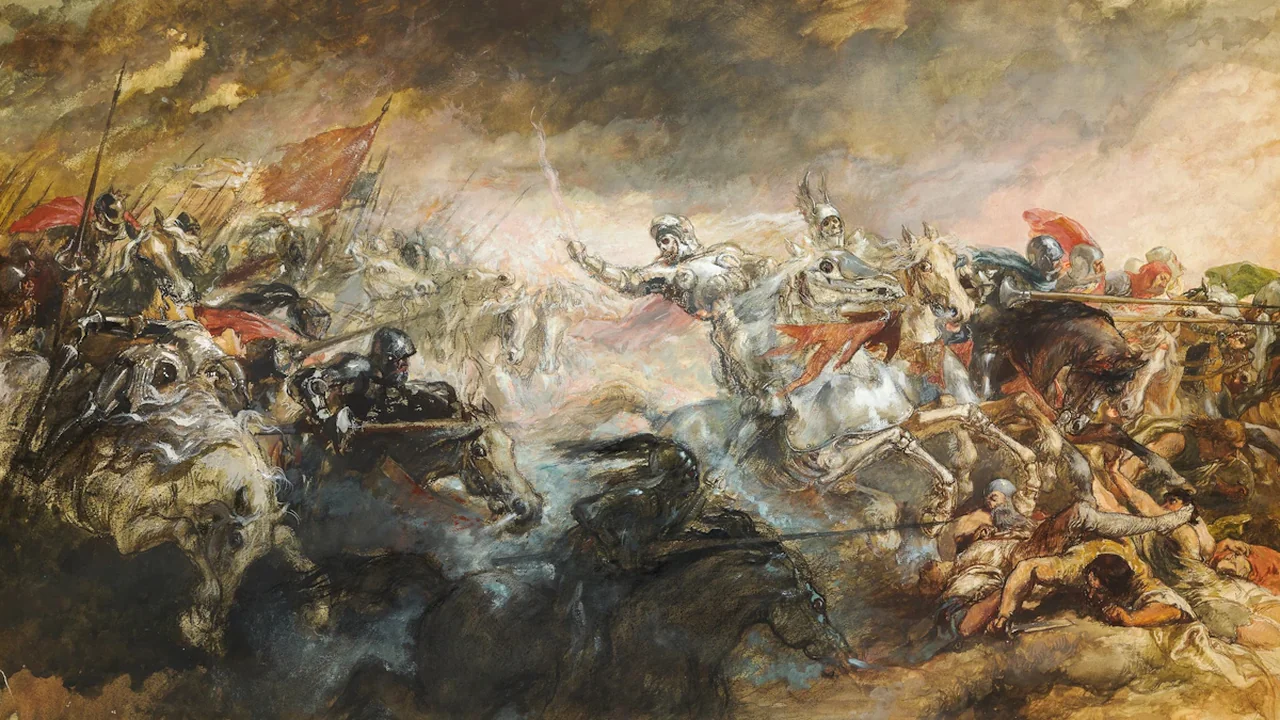
The Battle of Hastings was fought on 14 October 1066 near Hastings, in what is now East Sussex. William, Duke of Normandy, defeated King Harold II, opening the way for a change in England’s rulers. The victory was a turning point, but the Norman conquest continued through later military campaigns and political struggles.
14 October 1066: The battle near Hastings
The battle took place near the town of Hastings, in present-day East Sussex. William’s Norman forces met Harold’s English army after both rulers had claimed the English throne. The date is recorded by English Heritage’s Battle Abbey site, which marks the anniversary each October.
The contest followed a year of upheaval. Harold became king after Edward the Confessor died in January 1066, but his succession was challenged. William crossed the Channel to press his own claim, and the armies met in October after Harold had already fought another invading force in the north.
Why Harold and William both claimed the throne
The succession was disputed because there was no uncontested agreement about who should rule after Edward. Harold, an English nobleman, was chosen as king following Edward’s death. William argued that he had been promised the throne and that Harold had earlier pledged support for his claim. The exact circumstances and force of that alleged pledge remain matters historians assess through medieval accounts.
Harold’s claim rested on his election by leading English figures and his coronation. William’s claim drew on his asserted connection to Edward and on the promise he said Harold had made. Their competing claims turned a succession dispute into a military invasion; neither claim alone explains every political choice made in England in 1066.
The battle began the conquest; it did not finish it
William’s victory removed Harold from power and gave the Norman leader a decisive opening. Yet winning at Hastings did not instantly place every part of England under Norman control. William still had to secure recognition, take power in London and establish authority across a kingdom whose elites and communities did not all submit at once.

William was crowned king in Westminster later in 1066. Resistance continued after the coronation, and Norman rule was consolidated over subsequent years through further campaigning, punishment and changes in landholding and government. The battle is therefore best understood as the hinge between the old royal order and a longer conquest, not as a single day that settled every issue.
What historians can learn from the Bayeux Tapestry
The Bayeux Tapestry is among the best-known visual sources for the events leading to the battle and the Norman victory. Its embroidered scenes show people, ships, weapons and episodes associated with 1066. It offers valuable evidence about how the story was represented, as well as details of material culture that written accounts may not describe in the same way.
It is not a neutral photograph of the battle. The tapestry tells a story from a perspective sympathetic to the Norman cause, and its scenes have to be read alongside written sources and the circumstances in which it was made. Historians compare such evidence, consider what each source could know, and distinguish what is shown from what can be established independently.
Some familiar details of the battle remain uncertain, including the precise sequence of events and how particular episodes unfolded. Medieval accounts were written for different audiences and purposes, while later retellings can make contested points sound settled. Careful histories identify the broad outcome clearly while treating specific battlefield claims with caution.
The next milestone: William’s coronation
The next major milestone after Hastings was William’s coronation at Westminster on 25 December 1066. It marked his formal accession, but it did not bring the conquest to a close. The years that followed show how a battlefield victory became a lasting transfer of political rule in England.
Source: English Heritage, Battle Abbey
Context & actions About this article
Source check Historical context
The battle date is given by English Heritage’s Battle Abbey site; claims and battlefield details are presented with care where medieval evidence is contested.
- Battle date: 14 October 1066
- Battle location: near Hastings, East Sussex
- Bayeux Tapestry considered as a perspective-bearing source
- Source
- English Heritage, Battle Abbey
- Scope
- East Sussex, England
- Updated
- 2026-10-10 07:59
Source check
Report a trust issue
Send a clear signal to community moderation if the source, facts or context need review.




Comments