By the GlobeBids History Desk | 31 August 2026
Diana, Princess of Wales, died in Paris on 31 August 1997. The extraordinary public response that followed affected how Britain expressed collective grief, intensified scrutiny of press conduct and changed what many people expected from the monarchy during a national crisis. The anniversary remains a moment to distinguish documented events from the broader cultural interpretations built around them.
The essentials
- Diana combined royal duties with prominent work supporting charities and marginalised people.
- Public mourning filled civic and royal spaces with flowers, messages and long queues.
- Press intrusion and privacy became subjects of sharper public and political scrutiny.
- The monarchy faced stronger expectations for visible, immediate engagement with public feeling.
Diana’s public life extended beyond royal ceremony
Born Diana Frances Spencer in 1961, Diana married Charles, then Prince of Wales, in 1981. Their sons, Prince William and Prince Harry, were born in 1982 and 1984. The couple separated in 1992 and divorced in 1996, leaving Diana with a public role that was no longer defined solely by marriage.
The Royal Family’s biographical account records that she undertook duties on behalf of the monarchy and became president or patron of more than 100 charities. Her work included support for children, people experiencing homelessness and those affected by HIV and AIDS.
Some of her most widely remembered appearances challenged stigma through physical presence. At a time when misinformation about HIV transmission remained common, her contact with people living with HIV carried a clear public-health message. She also drew international attention to injuries caused by landmines.
That work did not make her public life uncomplicated. Her marriage, separation and relationships attracted intensive coverage, while her ability to communicate directly with audiences made her a celebrity on a global scale. Encyclopaedia Britannica documents both her royal position and the humanitarian causes that became central to her public identity.
Public mourning moved into streets and shared spaces
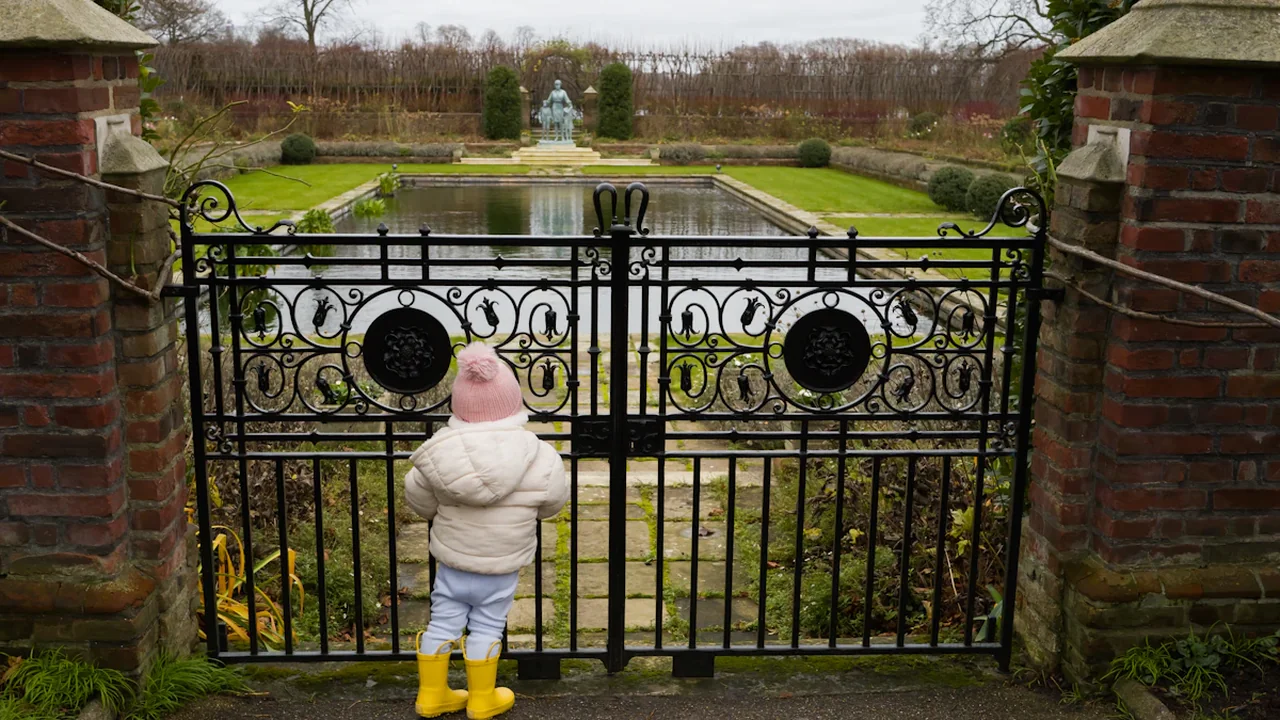
Following confirmation of Diana’s death, people gathered outside Kensington Palace, Buckingham Palace and other public locations. Large quantities of flowers, cards and personal messages accumulated at royal residences. Crowds also joined funeral queues and lined the route through London.
Her funeral was held at Westminster Abbey on 6 September 1997 and broadcast to audiences across Britain and internationally. These are documented events: the gatherings, floral tributes, public procession and televised service can be traced through contemporary reporting and broadcast archives.
The meaning assigned to that response requires greater care. It is often described as the moment Britain abandoned a supposedly reserved approach to grief. That is an interpretation, not a measurable overnight transformation in national character.
Public mourning had existed before 1997, and reactions to Diana’s death were not uniform. Millions participated or watched, but participation did not prove that every person felt the same way. Some observers were moved by the collective expression; others were uncomfortable with its scale or with assumptions that grief was universal.
What was unusual was the combination of royal symbolism, mass broadcasting, celebrity culture and direct public participation. People did not simply observe an official ceremony. They created their own memorial spaces, left personal testimony and expected institutions to recognise the emotional force visible outside palace gates.
Press conduct and privacy came under sharper scrutiny
Diana’s relationship with the press had long involved both visibility and intrusion. She sometimes used interviews and public appearances to communicate beyond formal royal channels, yet she was also persistently pursued and photographed. Those two facts can coexist; media access in some circumstances did not eliminate a person’s claim to privacy in others.
After her death, newspapers, photographers and editors faced intense criticism. The debate initially focused on aggressive pursuit by photographers, but it soon widened to encompass harassment, payment for images, the treatment of children and the responsibilities of editors who created demand for intrusive material.

It would be misleading to attribute Diana’s death to one profession or to treat every journalist and photographer as interchangeable. Questions of individual responsibility were examined through formal investigations and legal proceedings. A cultural history of the aftermath should not replace those findings with generalised blame.
The press-privacy debate also did not begin in 1997. Britain had already experienced disputes over tabloid methods and the adequacy of self-regulation. Diana’s death gave those concerns unusual public urgency, contributing to pressure for stronger professional standards and closer examination of harassment and privacy provisions.
Later legal developments, including privacy protections associated with the Human Rights Act 1998, had broader origins and should not be presented as a single-event response. Subsequent controversies and inquiries returned to many of the same tensions: press freedom, public interest, commercial demand and an individual’s right to a private life.
The distinction that still matters
Public interest is not identical to public curiosity. Reporting that exposes wrongdoing or enables democratic scrutiny has a different justification from persistent surveillance whose principal value is entertainment. The difficult cases lie between those poles, which is why Diana’s experience remains relevant to media-ethics discussions.
The monarchy faced new expectations of public visibility
In the days after Diana’s death, the Royal Family remained at Balmoral, where Prince William and Prince Harry were grieving privately. At the same time, visible public emotion grew in London, and criticism developed over the perceived absence of a sufficiently immediate institutional response.
Queen Elizabeth II returned to London and delivered a televised address on 5 September, speaking both as sovereign and as a grandmother. The funeral the following day combined royal, religious and public elements while placing Diana’s family and charitable associations at its centre.
The events did not formally rewrite Britain’s constitution or establish a new royal rulebook. Their longer significance is interpretive: they demonstrated that many people expected the monarchy to acknowledge public feeling quickly, communicate directly and balance inherited restraint with visible empathy.
That expectation has influenced how royal responses to later deaths, illnesses and family crises are judged. Silence may still protect privacy, particularly for children and close relatives, but it is also assessed as public communication. Institutions cannot assume that traditional reserve will automatically be understood as dignity.
Why 31 August remains a cultural reference point
Three changes are most defensible when kept within the evidence. Public grief became unusually participatory and visible; media conduct faced renewed scrutiny; and the monarchy encountered stronger pressure to respond in the emotional language of its audience.
None of those shifts had a single cause, and none was completed during one week in 1997. Television, tabloid competition, changing attitudes toward emotion and the growth of global celebrity culture were already reshaping British public life. Diana’s death brought those forces together with exceptional intensity.
The anniversary is therefore best approached without reconstructing the crash or repeating unsupported claims. Its enduring historical importance lies in what people did afterward—and in the unresolved questions their response raised about grief, privacy, public interest and the obligations attached to fame.
Source: Encyclopaedia Britannica
Context & actions About this article
Source check Sources and historical context
This account separates documented events from later interpretations of their cultural significance.
- Diana's date and place of death were checked against Encyclopaedia Britannica.
- Her royal position and charitable work were checked against the Royal Family biography.
- Claims about cultural change are identified as interpretations rather than direct facts.
- Unsupported allegations and graphic details have been excluded.
- Source
- Encyclopaedia Britannica
- Scope
- United Kingdom
- Updated
- 2026-08-31 18:09
Source check
Report a trust issue
Send a clear signal to community moderation if the source, facts or context need review.

Comments